Sunday, January 22, 2012

Scoot on, Scutaro

AP


Last night, as was first reported by Troy Renck of the Denver Post, the Red Sox traded shortstop Marco Scutaro to Colorado for RHP Clay Mortensen. It seems that the move was done purely for salary dumping purposes, as the team stands to save a little under six million. It is assumed that money will be reallocated into the search for starting pitching, but that remains to be seen.

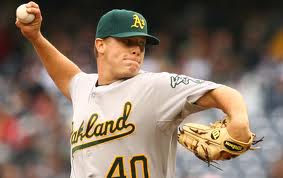
Mortensen has started more than half of the games he has appeared in during his short career, but has not put up great numbers. The first round pick in 2007 has struggled since his first year in pro-ball, and has never lived up to his first-round pick status. In 24 games a the big league level, he has not impressed. He doesn't strike guys out, walks guys a little more than average, and gives up home runs at a somewhat alarming rate. His strength is keeping the ball on the ground, with a career 51.3% ground ball-rate. Last year, in 16 games, he had a respectable  3.86 ERA, but his peripherals and 5.34 FIP both suggest that performance to be unsustainable. The hope for Red Sox fans has to be that a move away from Coors Field will help his startlingly high HR/FB ratio, although that ratio was 18.8% with most of his time spent in Oakland in 2009. He does have a remaining minor league option, and seems to be more starting pitching depth.

Scutaro on the other hand, was a good player for the Sox over the past two seasons, and has been worth 5.3 fWAR during that time. With him gone and shortstop currently vacated, it seems that Mike Aviles and Nick Punto will be platooning the position. I would expect Aviles to get the bulk of the starts, with Punto filling in for defensive purposes with a contact pitcher, or when Aviles spells Youkilis at third base. I would not expect Iglesias to be playing yet, as his offense still seems to be well behind his glove. All things considered, I'd expect the loss of Scutaro to be countered with the addition of a starting pitcher like Roy Oswalt, Edwin Jackson or Gavin Floyd. Although some don't like it, the team's budget worries are real and the move was necessary to land a SP, which is something this team needs badly.

My only complaint I have about the trade is the return. Sctuaro has been a very serviceable player at a scarce position in this league, at a relatively cheap price. It seems that this late in the offseason, with pretty much every other option off the board, some team could have ponied up more than a AAAA pitcher for his services. However, I can't say with absolute certainty the team could have done better, so I will hold off judgement on the deal until I see what move comes next. If, as expected, the team brings in one of the top starting pitchers available, the improvement of the pitching staff will outweigh the loss at shortstop, making this deal worth it.

Friday, January 13, 2012

The Killer B's

AP


Looking ahead to 2012, the Red Sox look to be pretty good at the top of the rotation, assuming health. Jon Lester is coming back as the staff ace, and he should improve a bit on his slightly disappointing 2011. I am not too worried about Lester, as last year was his first in which he did not eclipse the 200 inning plateau, and he still threw 191 innings. The question that I intend to find an answer for is just what can we expect out of the number two and three starters, Josh Beckett and Clay Buchholz, who I have horribly named "The Killer B's".

First, I will take a look at Josh Beckett. He is coming off a very good year in which, according to Fangraphs, he was worth 4.3 wins above replacement. Let me start this off by saying that the odd-year/even-year thing people love to say about Beckett is idiotic, and I refuse to mention anymore about that. He was able to have success last year despite a drop in his ground ball rate, which fell from around 46% down to 40%. He compensated for this by dropping his home run-rate below 1 for the first time since 2008 and dropping his walk-rate from 3.17 per 9 down to 2.42. Beckett's low ERA misrepresented how he actually pitched, though. His FIP was 3.57, compared to his stellar 2.89 ERA. A big reason for the discrepancy was his career-low and likely unsustainable .245 opponent's BABIP.

Looking ahead to next year, Beckett is due for some regression when it comes to ERA, but he can still be almost as valuable as he was in 2011. His velocity has been on a slight, but steady, downward trend, and averaged exactly 93 MPH last season. I'd expect it to drop a bit in 2012, but not to a detrimental extent. He has compensated by increasing his cutter and changeup usage, both of which showed marked improvement in terms of quality last year, as they were both above average pitches. If he can continue to throw his secondary pitches well, he should have similar success. Beckett's ground ball rate should also increase a bit back up to the mid-40's%. His K-rate is also in a steady decline, but it should stay above 8 per 9 innings, so there is nothing to worry about in his ability to miss bats. I expect a similar K/BB ratio as last year, which ended up at 3.37. All things told, Beckett's biggest key to this season will be his health. If he can stay on the mound, he should bring quality innings to this rotation, and contribute about 3-4 fWAR.

Buchholz is a must harder case to project. The 27 year old experienced a breakout of sorts in 2010, but was injured in June of last season and was unable to return for the rest of the season. Durability is the biggest question plaguing the Red Sox number three started. 2010 was the first season he pitched a full season at the Major League level, and even then he managed only 28 starts and 173.2 innings. As far as his actual pitching ability, he should be a very solid middle of the rotation starter if he can stay on the field. He induces ground balls about half the time, leading to a lower-than-usual opponents BABIP. Opponents have hit .279, .261, and .264 on balls in play the last three years, respectively. He doesn't have dominating strike out totals, with a K-rate in the 6-per-9 range the past three seasons. Buchholz also posts a decent mid-3's walk rate. Home runs are probably the biggest issue with him. In the breakout 2010 campaign, he held his HR-rate to 0.47, the only time in his career he's held that number below one. He probably won't sniff a rate that low again, but he can probably keep it around 0.8, assuming he is still able to keep the ball on the ground. Defense will be a big key for Buchholz. If the infield can keep balls in front of them, he should see some success as a ground ball pitcher. As long as he stays healthy, a 2-3 win season is very realistic for Buchholz, with a 3-4 win season as his probable ceiling. However, that is very valuable for a team with two very good pitchers at the top of their rotation, and one of the best lineups in the league.

The back end of the Red Sox rotation remains largely a mystery. Hiroki Kuroda, Roy Oswalt and Joe Saunders all still lurk in free agency. Daniel Bard and Alfredo Aceves are both expected to compete for a rotation spot in Spring Training. The team also added Aaron Cook and Carlos Silva to minor league deals for depth, have Felix Doubront on the horizon, and are reportedly looking at Vicente Padilla as well. With all those question marks, it is important the top of their rotation is sound. Jon Lester should be a capable ace, and the Killer B's should compliment him well, just so long that they can stay on the mound, which is a pretty big if when it comes to the two of them.

Thursday, January 12, 2012

Red Sox Trade PTBNL for Brad Emaus


The Red Sox continued their late-offseason small moves by trading for utility man Brad Emaus from Colorado in return for a player to be named later. Emaus can play either third or second base, and now joins Nick Punto and Mike Aviles as utility men on this 40-man roster. He is a very intriguing piece to be added to that group, since he is just 26 and still has all three options left. Because of this, he will likely begin the year at AAA Pawtucket.

Emaus was picked up by the Mets prior to the 2011 season in the Rule 5 draft. New York gave him exactly 14 games and 42 plate appearances before deciding he was not worth a spot on the 25-man roster, and shipped him back to Toronto, who swiftly waived him. He was then picked up by the Rockies, who kept him in AAA all year. He has played through five minor league seasons, and has spent the past two at the highest minor league level. He's shown potential to stick on a Major League roster throughout his minor league career.

His biggest asset has been his ability to control the strike zone, especially by drawing walks. He has been one of the guys who scouts aren't in love with because of his physical tools, but he has been able to stick around rosters. A reason for this has been his ability to draw walks. Throughout his minor league career, he has kept his walk rate in double digits, and even had it higher or equal to  his K-rate three times. This ability to control the zone has endeared him to some in the sabermetric community, and should allow him to get a chance at the big league level. He also showed some pop in the minors, but last year his .252 ISO at Colorado Springs is highly attributable to his home park, which is hitter-friendly.

Emaus can play two positions, but doesn't play either of them particularly well. Because of this, and his subpar speed, he will probably never be a good full-time player. However, with a little improvement of his bat, he should make a solid bench player. For this year, though, he may never see Fenway Park. The only probable way he will be called up to the big league roster is if Aviles or Punto goes down. So consider this yet another AAA-depth move by Ben Cherington.

Tuesday, January 10, 2012

Red Sox Sign Aaron Cook to Minor League Deal


As first reported by Ken Rosenthal, it appears the Red Sox have made another minor move in search of starting pitching depth, signing longtime Rockie Aaron Cook to a minor league contract. Cook will probably not be a game changer, but he has been in the league since 2002, and he is worth taking a more detailed look at.

Cook is going to be entering his age-33 season in 2012, so he isn't completely over the hill age-wise. He had two successful seasons in Colorado, producing 4.3 and 4.7 fWAR in 2006 and 2008, respectively. He did this mainly by preventing walks and forcing ground balls. He has a career 2.80 BB/9 ratio, and held that number under three for five consecutive years from 2005 through 2009. However, one of the reasons he never saw any major success in Denver was that he totally lacks the ability to strike people out. He actually set a career high in K/9 in 2011, but it was just a measly 4.45. Because of his lack of strikeouts, he has had one season with a FIP below four, and every other season stays in the 4-range. Basically, you know what you are getting from Aaron Cook. Low strike-outs, low walks, average-to-good home run prevention and high ground ball percentage. 

The reason for Cook's ground ball numbers are mainly due to his sinker, which he has thrown around 60% of the time the past two years. His fastball is far from overpowering, and he has been moving away from it the last two years. As his career has gone on, his velocity has steadily dropped to the 88-mph fastball he now throws. He also throws two breaking balls, a slider and a curveball, but both of those lead to more ground balls than missed bats. 

In the end, Cook was probably a good low-risk move for the Red Sox to make. Since he just signed a minor league deal, if he stinks the team can easily rid themselves of him. However, if he proves to be a competent pitcher, the team can keep in Pawtucket and call him up in case of emergency situations when starters go down with injuries. He reminds me of the Kevin Millwood signing last year, who ended up in Colorado by the end of the year, strangely enough. So while Cook is not the sexiest signing in the world, his low walks and high ground ball rate could prove to work out for this team in emergency situations.

Thursday, January 5, 2012

Bullpen's New, But is it Improved?


Ben Cherington has not done too much this offseason, much to the chagrin of some Red Sox fans. However, he has done a very good job rebuilding the bullpen after the departure of Jonathan Papelbon and possible transition to starting for Daniel Bard. He has also done so without giving up any major pieces of this team's present or future. However, was he able to improve the bullpen from what it was last year? To answer this question, I will assume the team will sign a number four starter (Please be Kuroda or Oswalt, not Saunders), and Bard will join the rotation as Aceves stays in the swingman role.

First, though, we will look back at last season. The group was led by Papelbon and Bard, who threw a combined 137.1 innings. As a whole, the Red Sox bullpen threw 517.1 innings, which was 5th most in baseball. This ranking probably says more about the starting pitchers than the bullpen, but the relievers performed admirably in all of those innings. As a group, they had the most fWAR at 7.7, and their 3.48 FIP was fourth best in MLB, and tops in the AL. As Peter Gammons tweeted yesterday, "Winning 90 games when your starting pitching ranked 2nd to last in innings and quality starts is remarkable". A big reason this was able to happen was that the bullpen was one of the top performing groups.

When comparing this year's bullpen to last year's group, I will first look at the first scenario, in which Bard leaves the back end of the bullpen and joins the rotation. In this scenario, the team must replace those 137.1 innings, as well as 4.8 fWAR, not an easy feat for just two relief pitchers to meet. Papelbon had possibly the best season of his career, and produced three wins all by himself. Firstly, we'll look at how the 8th inning will change. Last year, Bard appeared in 70 games and threw 73 innings, posting a 2.96 FIP. Taking his place will be newly acquired Mark Melancon. Last year in Houston, he put up comparable numbers, though slightly worse. He actually appeared in one more game and threw an inning and a third more, but his FIP was higher at 3.25, mainly due to less strike outs. His games and inning totals were far and away Major League career-highs for him, but if you add in his minor league totals as well, it was his third straight year of at least 68 innings, and there's no reason to think he can't pitch that many innings again in 2012. Next, looking at the 9th inning, the team will need to replace 63 games, 64.1 innings and a 1.53 FIP from Papelbon. Let's be honest, that isn't going to happen. However, Andrew Bailey can be very productive as the team's closer. He has been in the league for three years, and has posted sub-3 FIPs in each season. However, the biggest concern with Bailey is his health, as he has been under 50 innings each of the last two years. If he can stay healthy, he will bring the team about as close of value to Papelbon's 2011 as any closer in the game.

However, in the more likely scenario where he does not stay healthy throughout the 162 game schedule, the team will need its bullpen "wildcard" option, namely Bobby Jenks. The big free agent signing from last winter was either hurt or ineffective last season, but a return to form in 2012 would be a huge boost from this bullpen. Prior to last season, Jenks had been a premier relief pitcher in baseball for two of the previous three years.  Last season he lost all of the abilities that made him great, which was highlighted by his BB-rate skyrocketing to 7.47 per 9 innings, way above his 3.10 career mark. He also gave up a .429 BABIP in an incredibly small sample. If he can manage to stay healthy this year, I am optimistic he could give this team about 0.7 fWAR, which, for reference point, was what Alfredo Aceves contributed last year. Combine that with hopefully a little over 2 wins contributed from Melancon and Bailey, and this back of the bullpen can come close to matching the brilliance that was 2011 from Bard and Papelbon.

Of course, there are still other arms in the bullpen. Last year, in fact, they combined for exactly 370 innings last year. The point being, they are very important to this team. Assuming the team keeps 13 pitches, and five are starters and three were previously named, that leaves five spots for this years bullpen. Firstly, Alfredo Aceves has a definite spot in this 'pen. He isn't due for too much regression, but he probably won't be just as well due to some regression in BABIP and home runs. Overall, though, he should be a very good swingman. Next on the list is Matt Albers. He pitched extremely well to start the year, but faltered down the stretch. Realistically, his true talent is somewhere in the middle of that. His strikeouts spiked last year, and I fully expect those to come down, but he also had a 11.1% HR/FB ratio, so his home run totals should decrease. All of this should even out and Albers can be a solid middle reliever good for about 50-60 appearances. The next reliever on the roster is their current lefty-resident, Franklin Morales. He is substantially better against lefties, but definitely expect some regression. He significantly cut down his walk numbers last year, and I find it hard to believe he figured it out completely. He should walk about between four and five batters per 9 this year, and continue to give up home runs. Because of this, I see Rich Hill possibly making a return to the bigs this year to take over the LOOGY role, which I discussed yesterday. The rest of their bullpen will be built on young arms such as Felix Doubront and Michael Bowden.

As a whole, the bullpen will not be as good as last year. It is almost impossible to make up for two losses as big as Bard and Papelbon, and their middle relief is probably due for some regression. However, this is not all negative. They should still be at least league-average, and Bard's value expands if he can stick in the starting rotation. On top of this, the team should not have to use their bullpen arms as often as last year. Their starting pitching *should* stay healthier this year, meaning less stopgaps consistently throwing five inning starts and wearing everybody out. So although the bullpen may not be as strong as 2011, it is one that should be able to be counted on in 2012.

Wednesday, January 4, 2012

Quick Rundown of the 12 Minor Leaguers Signed Yesterday

On Tuesday, the Red Sox made 12 Minor League signings, some of which are more intriguing than others. Here's a quick blurb for each of the 12. (In parentheses will be what age-season 2012 will be for the player).


Carlos Silva (age-33 season)
Silva is an interesting signing, but one that likely won't be much of a return. He has pitched in 29 Major League games in the past three years, and managed only seven Minor League appearances last year due to injury. When he was healthy, he was a control master, with a career 1.73 BB/9. However, he always gave up a bunch of home runs, and really can't be expected to be much more than replacement level at this point.


Brandon Duckworth (age-36 season)
Duckworth is an older pitcher who has been bouncing around the professional ranks since the late 90's and broke into the bigs in 2001. He has never really stuck, pitching in just 134 games in the past decade, and hasn't thrown a big league pitch since 2008. The soft-throwing righty probably won't get his chance this year, either.

Charlie Haeger (age-28 season)
Haeger is most well known for his knuckle ball, which is a dying pitch in this game. To be quite frank, he will not be the one resuscitating it. He actually began last year in Double-A Portland, and pitched decently for them. However, he has struggled at almost every other place he's ever pitched, including a 5.85 FIP and -0.6 fWAR in 34 career Major League appearances.

Will Inman (age-25 season)
Inman is probably the most exciting pitcher so far, just because he is young enough where improvement isn't out of the picture. After excelling in the lower levels of Milwaukee's Minor League system, he struggled a bit in his adjustment to AA. However, the next two years in San Diego's system at that level he returned to decent form, keeping his FIP in the 3's in those seasons. However, his adjustment to AAA has been basically awful, as he is struggling mightily to keep the ball in the yard. Perhaps a change of scenery was needed, but at this point he doesn't look like much more than a quick injury replacement in the bullpen.

Doug Mathis (age-29 season)
Mathis is another intriguing signing who has had some sort of success at the big league level. His velocity sits in the low 80s-high 90s, and he pitched 37 games for the Rangers in 2009-20010. 2009 was his best year, as he had 24 appearances and held his BB/9 down at 2.11. This was good enough for a 3.99 FIP and 0.4 fWAR. Fangraphs has rated only his slider as above average, and even that is just barely. He started 17 games at AAA last year and struggled with control and had a FIP above 4.

Tony Pena Jr. (age-31 season)
Pena is one of the more interesting players in baseball. He broke into the big leagues as an infielder and even was a regular for the Royals in 2007. However, his allergy to walks made it so trying to pitch was the only way to keep his career going. He doesn't have a 31 year old arm, as last year at Pawtucket was his first substantial pitching work. He pitched pretty well, with a 1.81 K/BB ratio and a 3.97 FIP. If some natural improvement comes as he gets used to throwing off a mound, he could get some spot usage in the Fenway bullpen.

Chorye Spoone (age-26 season)
Spoone has spent his entire career in the Orioles system, and has shown that he does not have what it takes to be a starter. According to scouting reports, he has a fastball that sits in the 90-95 range, and a plus curveball that can make him an effective reliever at some point. However, at no point during his minor league career has he shown any semblance of control. 


Jesse Carlson (age-31 season)
Carlson was actually signed back in December. He missed all of last season due to rotator cuff surgery. However, he does bring 162 games of experience in the AL East, as he spent the previous three years in Toronto. He has struck out righties at a higher rate, but the lefty gave up less walks and less home runs to fellow lefties, explaining his improved FIP. Only time will tell how he returns from injury, but he has shown an ability to perform at the big league level previously in his career.

Rich Hill (age-32 season)
This is probably my favorite signing of all of these low-level deals. Hill was with the team last year and probably represented their best left-handed pitcher for the short time he was in the 'pen. He was striking out batters at a high rate in a small sample size. He missed most of the year after undergoing Tommy John surgery, but if he is able to recover smoothly, expect to see Rich Hill on big league mounds this year.

Justin Thomas (age-28 season)
Thomas is a guy who has limited big league experience, but is a lefty and is worth the shot at AAA. He is a soft thrower, but has a plus-slider that punishes lefties. Control has been an issue with him, as have strikeouts at the big league level. He has shown potential for strikeouts in the minors, but hasn't been able to translate that skill to the Majors. 

Pedro Ciriaco (age-26 season)
The first batter on the list, Ciriaco is a shortstop with a plus-glove, plus-speed, and a not-so-plus-bat. He has never shown any semblance of an ability to walk, posting a BB-rate no higher than 4.0% since reaching High-A ball. In a small 40 plate appearance sample size, he has posted somewhat surprising batting stats. He has a .370 wOBA and 134 wRC+, but this is mainly due to an utterly unsustainable .433 BABIP. He will be no more than a pinch runner/defensive replacement.

Nate Spears (age-27 season)
Spears is a utility guy who has been in the Sox system for the past two years, even earning a three-game, four-plate appearance stint with the big league squad last year. Sox Prospects describes him as a "David Eckstein-type," and he has apparently made enough of an impression for the team to bring him back. He has shown an above-average ability to draw walks, and has shown decent power in the Sox system. He will never be anything special, but can contribute here and there.